
Season’s refresh : A collection of exclusively curated handloom sarees | Shop Now

Mul Cotton Saree: Bengal’s Featherlight Summer Classic
Weave Guides · 4 minute read
There is a reason your grandmother’s summer wardrobe was built almost entirely from one cloth. The mul cotton saree is Bengal’s answer to heat: a muslin-weight handloom so fine and so soft that wearing it feels closer to wearing air than wearing fabric.
Mul, or mulmul, is spun from long-staple cotton and woven at a high thread count on a handloom. The result is a drape that weighs almost nothing, breathes constantly, and gets softer with every single wash.
Here is what makes this weave special, how to tell the real thing from a mill copy, and how to keep yours going for years.
On this page
What is a mul cotton saree?
Why mulmul is the perfect summer handloom saree
How do you spot genuine handloom mulmul?
Styling and care tips
Handwoven by our family of weavers
Related questions
What is a mul cotton saree?
A mul cotton saree is a plain-weave handloom saree made from very fine cotton yarn, usually in the 80s to 120s count range. The higher the count, the thinner the thread and the more gossamer the finished cloth.
The word mul comes from mulmul, the Bengali and Hindi name for this class of soft muslin. It is the direct descendant of the legendary Dhaka muslins that were once traded across the Roman and Mughal worlds.
What separates it from ordinary cotton is the finish. Mill cotton is stiffened with starch and sizing to look crisp on a shelf. True mulmul is soft in the hand from day one because the softness comes from the yarn itself, not from a chemical coating.
Did you know? The historic muslins of Bengal were described with poetic trade names like baft-hawa, which translates roughly to “woven air.” A full length of the finest grade could reportedly be drawn through a finger ring.
Why mulmul is the perfect summer handloom saree
Indian summers are not just hot, they are humid. A fabric that traps moisture against the skin becomes unbearable by noon, which is exactly where synthetics fail.
Mul cotton solves this with its open weave. Air moves through the cloth continuously, and the cotton fibre pulls perspiration away from the skin so it can evaporate rather than sit.
The weight helps too. A six-yard mul saree folds down small enough to disappear into a handbag, which makes it a genuinely practical summer handloom saree for travel, long workdays and afternoon events.
And unlike heavier weaves, it needs no petticoat gymnastics to sit well. It falls in soft, fluid pleats on its own.
How do you spot genuine handloom mulmul?
Handloom cloth carries small honest irregularities that machines cannot fake convincingly. Learn to read them and you will rarely be fooled.
Hold the saree up to daylight. Genuine mulmul is slightly translucent and you should see a faint, uneven grid where the warp and weft cross.
Check the reverse side. On a real handloom, the back of the border and any extra-weft motif looks worked rather than perfectly printed.
Feel it before it is washed. If a “cotton” saree feels papery and crisp in the shop but limp after one rinse, that crispness was starch. Compare it against a good handspun khadi saree or a piece from our cotton handloom collection and the difference becomes obvious quickly.
Styling and care tips
Mulmul rewards simplicity. Because the cloth is so light, the styling should be light too.
- Wash cold, by hand, with a mild detergent. Hot water and harsh soap will weaken fine cotton yarn faster than anything else.
- Never wring it. Press the water out gently between your palms or roll it in a towel, then dry it flat in shade so the colours hold.
- Starch lightly if you want structure. A weak rice-water starch is the traditional trick and it rinses out clean next time.
- Iron on medium while slightly damp. This is when the pleats set best and the fabric relaxes.
- Store folded in cotton, not plastic. Refold along different lines every few months so permanent creases never form.
- Style it with contrast. A raw silk or handloom cotton blouse and one piece of oxidised silver jewellery is all a mulmul drape needs.
Handwoven by our family of weavers
Every mul saree at Label Iplik comes off a pit loom worked by hand, not off a power loom. Our family of 50+ weavers sets the warp, throws the shuttle and finishes each border themselves.
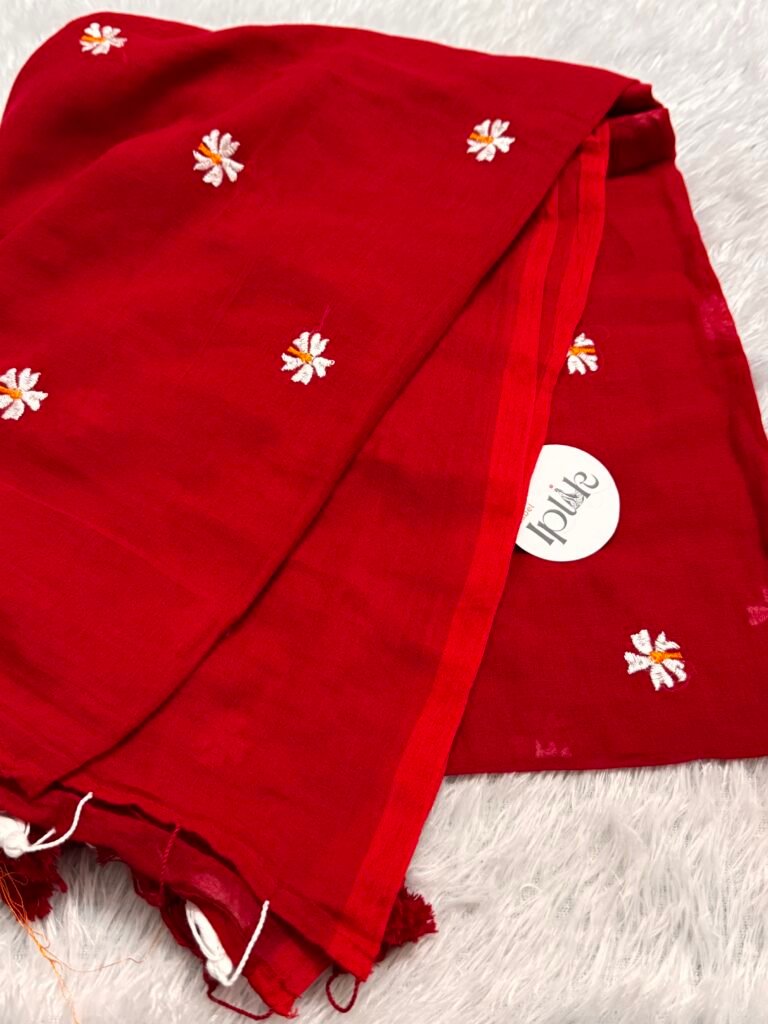
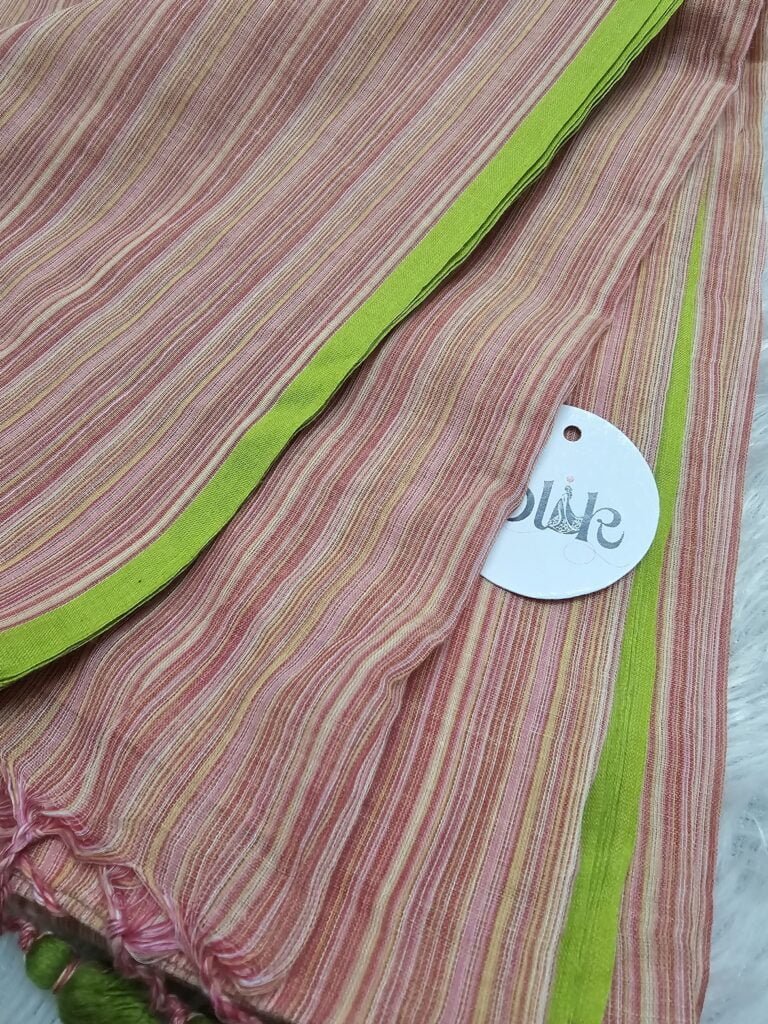
That is why no two pieces are identical, and why buying one supports a household rather than a machine. Our mul cotton saree collection runs from quiet single-tone drapes to striped and floral pieces like the Shiuli Red mulmul saree.
Shop the Mul Cotton Collection
Related Questions
Is mul cotton the same as mulmul?
Yes. Mul is simply the shortened form of mulmul, the traditional name for fine, soft muslin-weight cotton woven in Bengal and other handloom regions of India.
Is mul cotton see-through?
Fine mulmul is slightly sheer by nature, which is part of its appeal. A well-fitted petticoat and a lined blouse handle this completely, and heavier counts are noticeably more opaque.
Does a mul cotton saree shrink?
A small amount of shrinkage in the first wash is normal for pure handloom cotton. Washing cold and drying flat in shade keeps it minimal.
Can I wear a mul cotton saree to a wedding?
For daytime functions, mehendi mornings and haldi, absolutely. Choose a piece with a zari or contrast border and pair it with statement jewellery.
The everyday saree worth owning
A mul cotton saree is not a once-a-year purchase that lives in a trunk. It is the drape you reach for on ordinary mornings, and it improves every year you own it.
Browse the full range of handwoven pieces in our saree collection, with free shipping across India and easy returns.