Season’s refresh : A collection of exclusively curated handloom sarees | Shop Now

Ajrak Block Printing on Modal Silk: An Ancient Craft, Reborn
Some crafts survive because they refuse to be hurried. Ajrak block printing is one of them — a resist-printing tradition more than four thousand years old, in which cloth is washed, dyed, printed and sun-dried over and over until deep indigos and maddery reds settle into hypnotic geometry. Today, artisans are carrying this ancient art onto a thoroughly modern canvas: modal silk. The result — ajrak block printing on modal silk — is a saree that carries centuries of skill yet drapes like water. Here is how the craft works, and why the modal pairing has won so many hearts.
What Is Ajrak Block Printing?
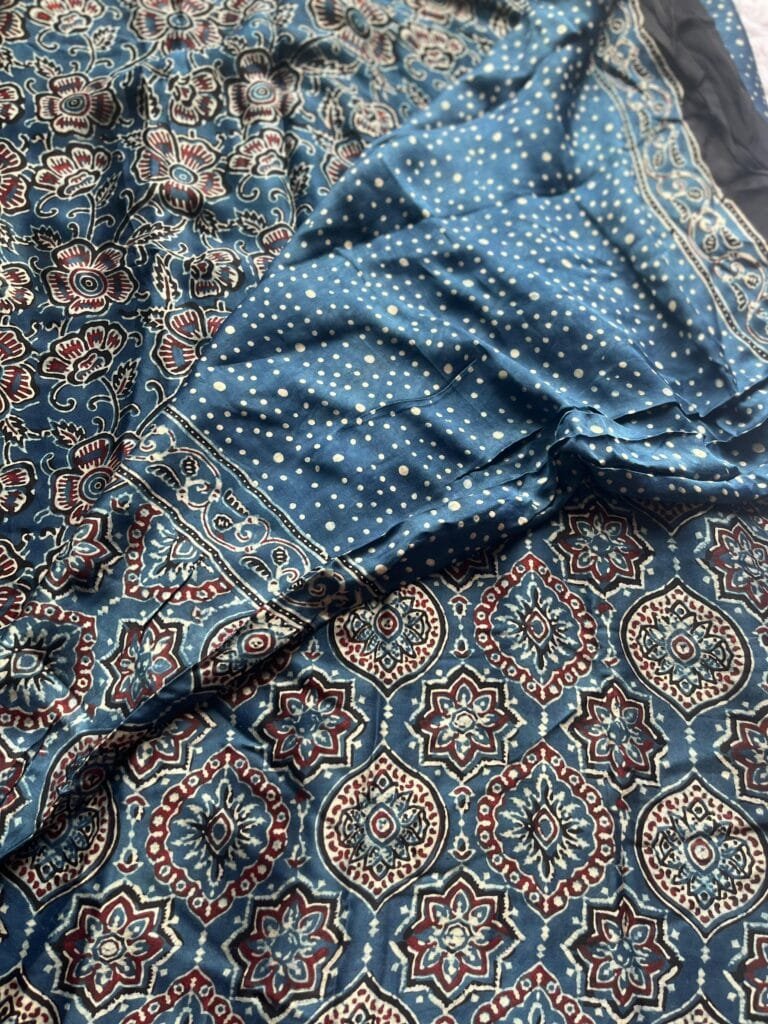
Ajrak (also spelt ajrakh) is a hand block printing tradition rooted in the Sindh region and in Kutch, Gujarat, where the Khatri community has practised it for generations. Its name is often traced to the Arabic azrak, meaning blue — fitting, since indigo is the soul of the craft. Unlike ordinary printing, ajrak is resist printing: parts of the cloth are blocked off with lime and gum pastes so the dye cannot reach them, and the pattern emerges in the negative spaces as much as the printed ones. Carved wooden blocks, some passed down within families, are stamped by hand with astonishing precision — the classic designs align on both sides of the fabric.
Sixteen Steps and a Lot of Patience
A true ajrak goes through a long sequence of stages — traditionally counted at fourteen to sixteen — spread over two to three weeks. The cloth is first washed and treated with castor oil and camel dung to soften it, then soaked in myrobalan (harda), which gives the base its warm tint and helps dyes bond. Outlines are stamped in resist, then come rounds of indigo and alizarin dyeing, each followed by washing and drying in the open sun, which slowly deepens the colours. Natural materials do the colouring: indigo for blue, madder root for red, iron-and-jaggery ferment for black, pomegranate rind for softer notes. No two lengths ever emerge identical — which is precisely the charm.
Why Ajrak on Modal Silk Feels So Special
Traditional ajrak lived on sturdy cotton. Modal — a fine, plant-based fibre celebrated for its silky hand-feel — changes the experience entirely. It drinks up natural dyes, so the indigos look deeper and the maroons richer, and it drapes with a fluid, almost liquid fall that cotton cannot match. It is also breathable and light, making it as comfortable in an air-conditioned boardroom as at a winter wedding. Our Modal Ajrak collection pairs these hand-printed lengths with plain woven borders so the geometry stays the hero — see the blue-on-blue Modal Ajrak – Blue for a classic example of the style.
Reading the Geometry
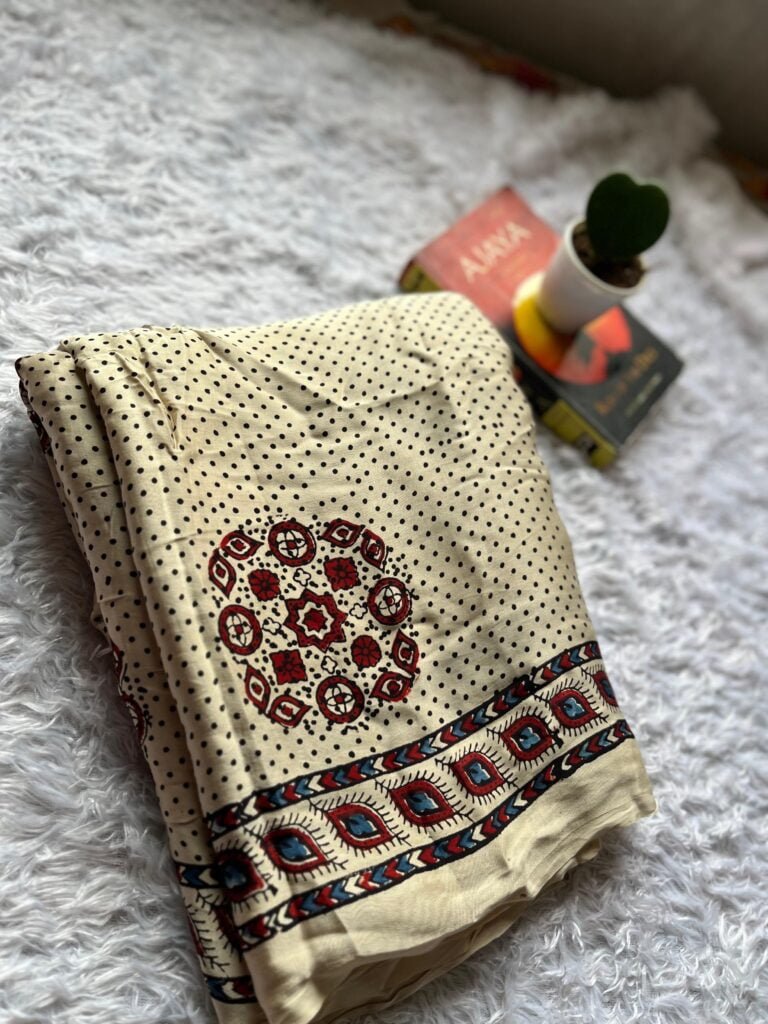
Ajrak patterns are a quiet language. Star lattices, trefoils, and the beloved cloud-and-riverbank borders repeat in strict symmetry, said to echo Islamic architecture and the night sky over the Indus. The palette is equally coded: indigo blue for the heavens, madder red for the earth and twilight, white for clouds, black for night. Where painted crafts like Kalamkari tell stories in free-flowing figures, ajrak meditates on order — its beauty lies in repetition done perfectly, by hand, thousands of times.
How to Spot the Real Thing
With screen-printed imitations everywhere, a few tells help you find genuine hand block ajrak:
- Look at the reverse — in traditional ajrak the pattern shows through or is printed on both faces, not blank white.
- Welcome tiny imperfections: slight block misalignments and depth variations are signatures of the human hand.
- Smell and touch: naturally dyed cloth has a soft, earthy scent and a matte depth that chemical prints lack.
- Check the palette: true ajrak leans on indigo, madder red, black and cream — neon shades are a red flag.
- Price honestly reflects weeks of labour; an unbelievably cheap “ajrak” usually isn’t one.
Caring for Your Ajrak Saree
Natural dyes reward gentle habits. Dry clean the first few times, then hand wash cold with a mild, bleach-free detergent, always separately. Dry in shade — harsh sun fades indigo — and iron on the reverse. Stored with a muslin cover away from damp, an ajrak on modal silk mellows beautifully with age, the way all good handloom does.
At Label Iplik, every drape is crafted the slow way by our family of 50+ weavers and artisan partners. Explore our handloom saree collections — with free shipping across India — and bring home a piece of living craft.