
Season’s refresh : A collection of exclusively curated handloom sarees | Shop Now

Long before machines hummed in mills, cloth in India was born on the handloom — thread by thread, in villages from Bengal to Tamil Nadu. The history of Indian handloom weaving is really the history of the subcontinent itself: its trade, its art, its struggle for freedom, and its everyday life. This guide traces that journey, from ancient cotton fields to the living looms that still clothe us today, and explains why every handwoven saree carries centuries of skill in its folds.
Where It All Began
India was spinning and weaving cotton at least five thousand years ago. Archaeologists have found spindles and traces of dyed thread at Indus Valley sites like Mohenjo-daro, and ancient Greek and Roman writers marvelled at Indian muslin so fine it was called “woven wind.” For centuries, Indian handwoven cloth was a global luxury, traded across the Roman Empire, Southeast Asia, East Africa and the Arab world. Weaving was not a hobby; it was a highly respected craft passed down through families, each region developing its own techniques, motifs and signature yarns. Knowledge of dyeing, spinning and loom-setting was guarded and refined over generations, making certain villages famous for a single, unmistakable style.
The Golden Age of Indian Handloom Weaving
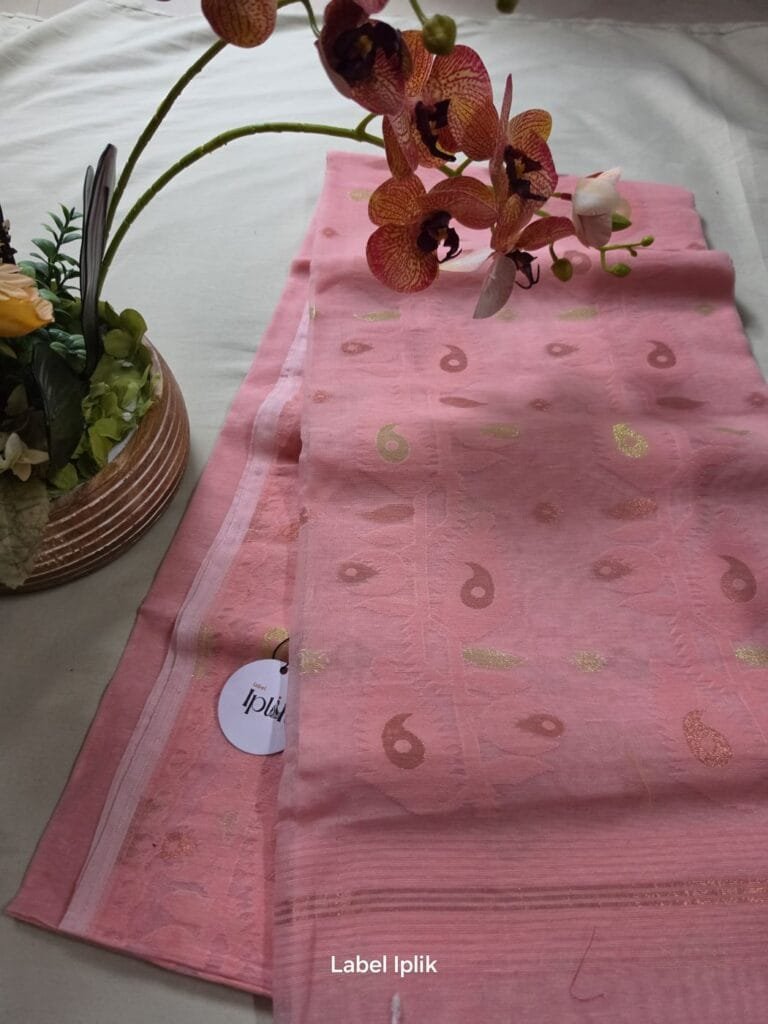
By the medieval and Mughal era, Indian handloom weaving reached extraordinary heights. Royal courts commissioned gossamer muslins, gold-threaded brocades and intricate figured weaves. Bengal’s Jamdani, woven with supplementary-weft motifs that seem to float on the surface of the cloth, became world-famous, while South India perfected lustrous silks and temple borders. Cities such as Dhaka, Varanasi and Kanchipuram grew wealthy on cloth, and Indian textiles set the standard for luxury across three continents. This was an economy built entirely on human hands, where a single master weaver could spend months on one heirloom drape, and where a bolt of fine muslin could be worth more than its weight in silver.
Colonial Disruption and Decline
The arrival of British colonial rule changed everything. Cheap machine-made cloth from Manchester mills flooded Indian markets, while heavy taxes and one-sided trade policies undercut local weavers. Skilled artisans who had once supplied the world were pushed into poverty within a few generations, and entire weaving towns shrank. Yet the craft never fully disappeared — it survived in villages, in wedding trousseaus, and in the stubborn pride of weaving communities who refused to let their looms fall silent even when it was no longer profitable to keep them running.
Revival and the Freedom Movement
Handloom became a powerful symbol of resistance during India’s independence struggle. Mahatma Gandhi urged people to spin their own yarn and wear hand-woven Khadi as an act of self-reliance, turning the humble charkha into a national emblem that still appears in the story of the flag. After independence, government boards, weaver cooperatives and the Handloom Mark were created to protect artisans and certify genuine handwoven cloth. That deliberate revival is the reason so many regional traditions are still alive for us to wear today rather than surviving only in museums.
Regional Weaves That Survived
Much of India’s weaving heritage lives on in distinct regional traditions, each with its own unmistakable character:
- Jamdani — Bengal’s feather-light muslin with hand-inlaid motifs.
- Khadi — hand-spun, hand-woven cloth born of the freedom movement.
- Kota Gadwal — airy checked-grid cotton-silk from Rajasthan and Telangana.
- Mahabalipuram & South Indian silks — rich, lustrous drapes with temple borders.
- Begumpuri — Bengal’s crisp, wide-bordered everyday cotton.
Each of these weaves is a living link to the history described above — the same techniques, refined over generations, still worked by hand on wooden looms.
Handloom Today
Today, handloom is enjoying a quiet renaissance. A new generation values cloth that is sustainable, breathable and made by real people rather than machines. Every handwoven saree uses a fraction of the energy and water of industrial textiles, and buying it supports rural weaving families directly, keeping ancient skills from being lost. When you drape a handwoven saree, you are not just wearing fabric — you are carrying forward one of the oldest continuous craft traditions in the world.
Want to wear a piece of that history? Explore our collection of handwoven handloom sarees, crafted by our family of 50+ weavers, with free shipping across India — your next heirloom is only a click away.