
Season’s refresh : A collection of exclusively curated handloom sarees | Shop Now

Kantha Stitch Explained: Bengal’s Running-Stitch Magic
The kantha stitch is proof that the simplest things in textiles are often the hardest to master. It is nothing more than a plain running stitch — needle in, needle out — yet in the hands of Bengal’s women it becomes rippling texture, story-filled motifs and quilts that hold three generations of cloth together. If you have ever run your fingers over a kantha saree and felt that gentle, wave-like crinkle, you have touched a tradition that began not in a workshop but in village courtyards, with worn-out sarees too loved to throw away.
What Exactly Is the Kantha Stitch?
At its heart, kantha is a small, even running stitch worked in long rows across layered cloth. When thousands of these stitches sit side by side, they pull the fabric ever so slightly, creating kantha’s signature rippled, quilted surface. The stitch does two jobs at once: it binds layers of soft cotton together, and it draws — because by simply changing direction, spacing and thread colour, the same humble stitch outlines lotuses, fish, birds and whole village scenes. No frames, no fancy equipment; just a needle, thread and extraordinary patience.
Born of Thrift, Raised on Love
Kantha began in rural Bengal as a way of giving old cloth a second life. Women layered five or six worn mul cotton sarees and dhotis, then quilted them together — often using thread carefully pulled from the sarees’ own coloured borders. The result was the original kantha: a soft, breathable quilt for babies and winter nights, made entirely from memory and reuse. Because these were made for family rather than for sale, each one carried personal touches — a grandmother’s favourite flower, a fish for prosperity, initials worked into a corner.
Motifs That Tell Stories
Kantha has no strict pattern book, which is exactly its charm. Still, certain motifs return again and again: the lotus at the centre as a symbol of purity, the tree of life spreading from corners, fish and water creatures for fertility and plenty, birds, elephants, and scenes of everyday village life — a bullock cart, a comb, a mirror. The empty spaces between motifs are filled with running-stitch waves, so the entire surface shimmers with movement.
The Many Types of Kantha
Over time, distinct styles of kantha developed for different uses:
- Sujani kantha — large quilts and spreads, the classic layered form.
- Lep kantha — thicker, warmer quilts with wave-like stitching.
- Archilata kantha — small covers for mirrors and combs, with wide borders.
- Oaar kantha — pillow covers with simple borders and rows of stitching.
- Nakshi kantha — the celebrated “story kantha”, densely embroidered with elaborate figurative scenes.
Kantha on Sarees Today
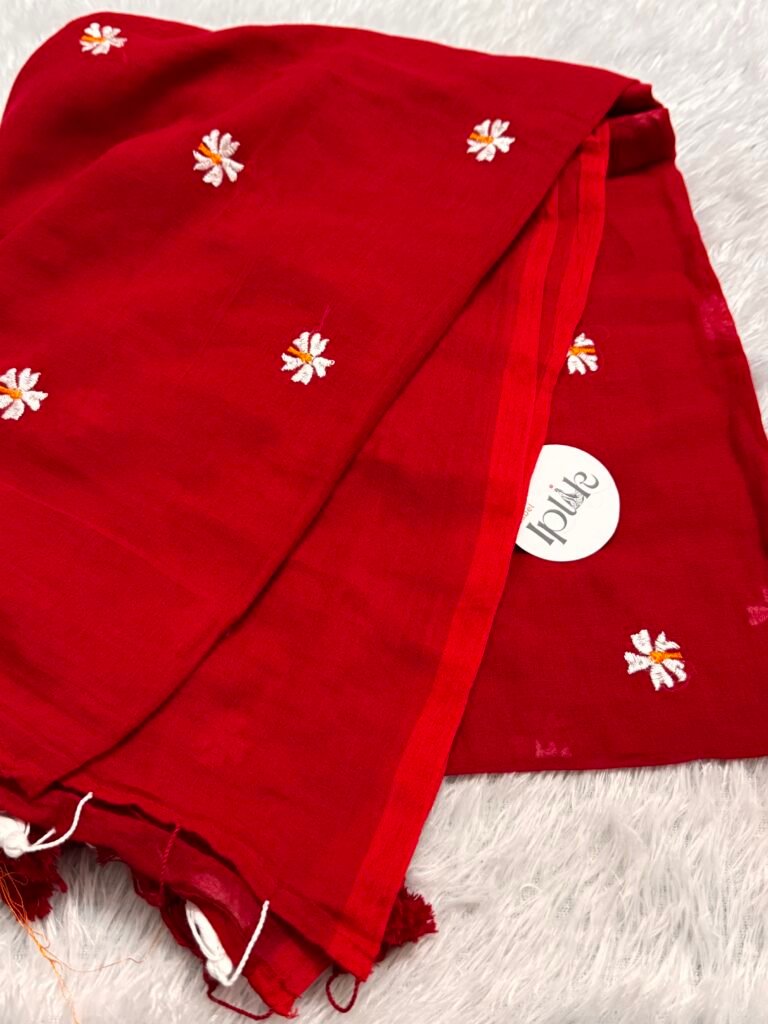
What began on quilts now dances across drapes. On a saree, kantha work is usually embroidered over soft, breathable bases — mul cotton, silk and khadi all take the stitch beautifully. The gentle pull of the stitching gives the fabric a lived-in, textural quality no printed imitation can match. It sits naturally alongside Bengal’s other great textile traditions, from the airy Jamdani weave to hand-spun Khadi — crafts where the human hand is visible in every inch. A soft mul drape like our Shiuli Red mulmul saree shows exactly the kind of cloth this tradition grew up on.
How to Spot Real Kantha — and Care for It
Genuine hand-done kantha reveals itself on the reverse: you will see the stitches clearly, with small, human irregularities in length and spacing. Machine imitations look suspiciously perfect and flat. To care for kantha work, hand wash gently in cold water with a mild detergent, never wring or twist, and dry flat in shade to protect both thread and base cloth. Iron on the reverse at low heat so the stitches keep their gentle relief, and store folded in a breathable cotton bag, refolding along new lines every few months.
A kantha piece is never just decoration — it is hours of quiet handwork you can feel under your fingertips. Explore our full collection of handwoven handloom sarees, crafted by our family of 50+ weavers, with free shipping across India.